Series: Stochastic Approximation from First Principles · Part 1 of 22
Stochastic approximation studies a basic question: can an iterative update converge when every target observation contains noise? Robbins and Monro introduced the framework in 1951, and Dvoretzky gave a general convergence theorem in 1956. Its basic form is:
$$ \text{New}=\text{Old}+\alpha(\text{Target}-\text{Old}). $$Imagine searching for a river at night. Let $w_k$ denote your actual position after step $k$. The riverbank has a fixed true location $w^*$, but you cannot see or use it directly. You can only listen to the water and form a location judgment, $\text{target}_k$.
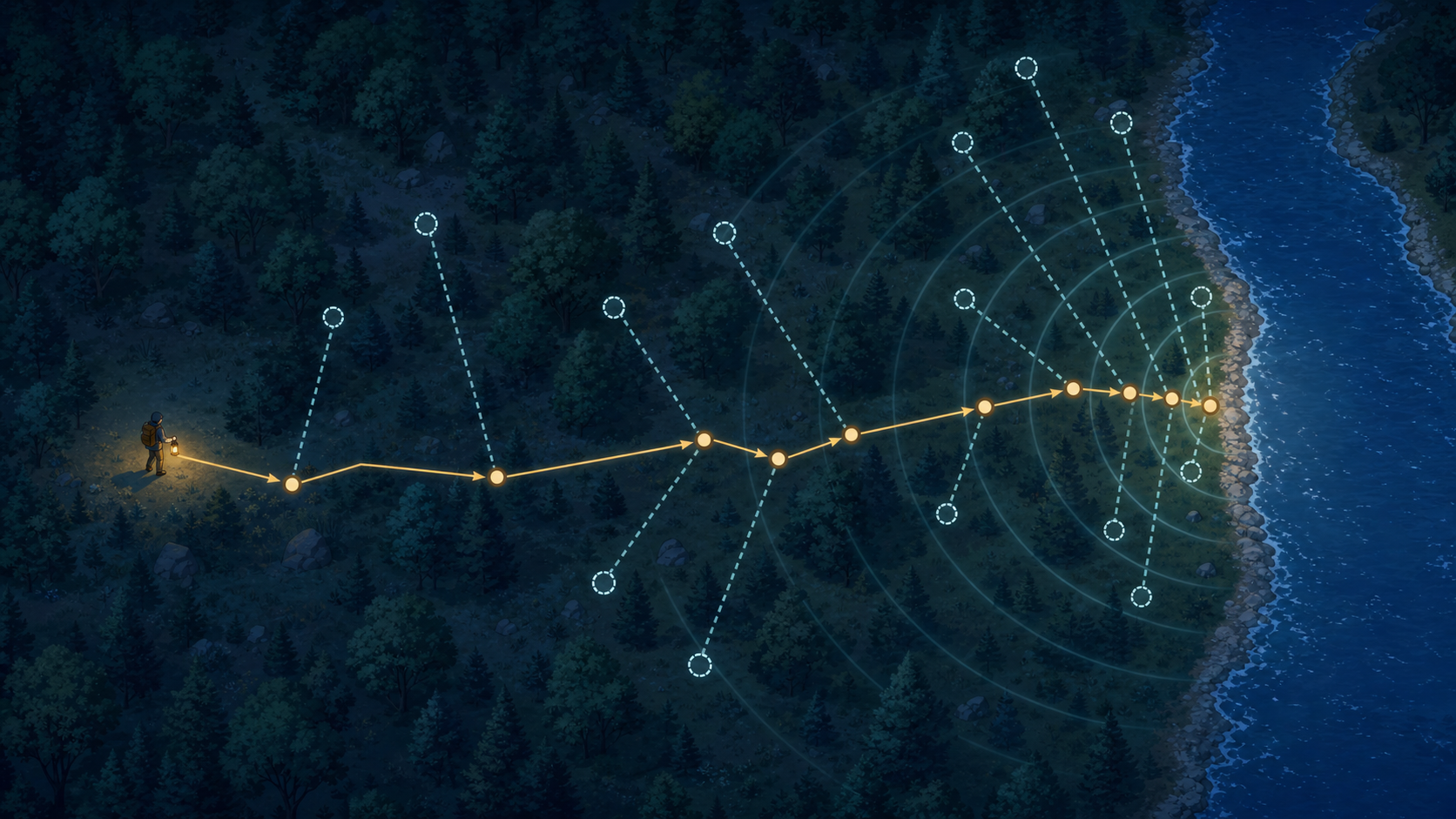
The Actual Update Uses Only the Noisy Target
Wind, leaves, echoes, and terrain can shift this estimate away from the true location:
$$ \text{target}_k=w^*+\eta_k, $$where:
$$ \eta_k=\text{target}_k-w^* $$is the location error caused by the current judgment. This equation belongs to the analyst’s view: the traveler observes $\text{target}_k$, not $w^*$ or $\eta_k$ separately.
The traveler can execute:
$$ w_{k+1}=w_k+\alpha_k(\text{target}_k-w_k). $$This update uses only the current position, the latest inferred river location, and the chosen movement fraction. The difficult part is now visible: every step must follow a target that may be wrong.
The Step Size Is a Movement Fraction
You should not completely trust one sound-based judgment. The coefficient $\alpha_k$ is:
The fraction of the vector from your current position to the latest inferred river location that you actually walk.
With $\alpha_k=1$, you move directly to $\text{target}_k$. With $0<\alpha_k<1$, you move only partway and leave room for later judgments to correct the route.
Stochastic approximation allows this fraction to change over time:
$$ \alpha\longrightarrow\alpha_k. $$Read the Update as a Weighted Position
The same expression can be written as:
$$ w_{k+1}=(1-\alpha_k)w_k+\alpha_k\text{target}_k. $$The new physical position is a weighted combination of the current position and the latest inferred river location.
A Concrete Step
Use a one-dimensional east-west coordinate. Suppose you are at $w_k=0$ meters, the latest sound suggests $\text{target}_k=120$ meters, and $\alpha_k=0.25$. Then:
$$ w_{k+1}=0+0.25(120-0)=30\text{ meters}. $$You can complete this action without knowing the true riverbank. If an outside observer knows that $w^*=100$ meters, that observer can also say that the current judgment error was $\eta_k=20$ meters. The true location enters the analysis, not the traveler’s calculation.
This leaves the central question for the rest of the series:
Under what conditions does $w_k$ converge to the unobserved target $w^*$?