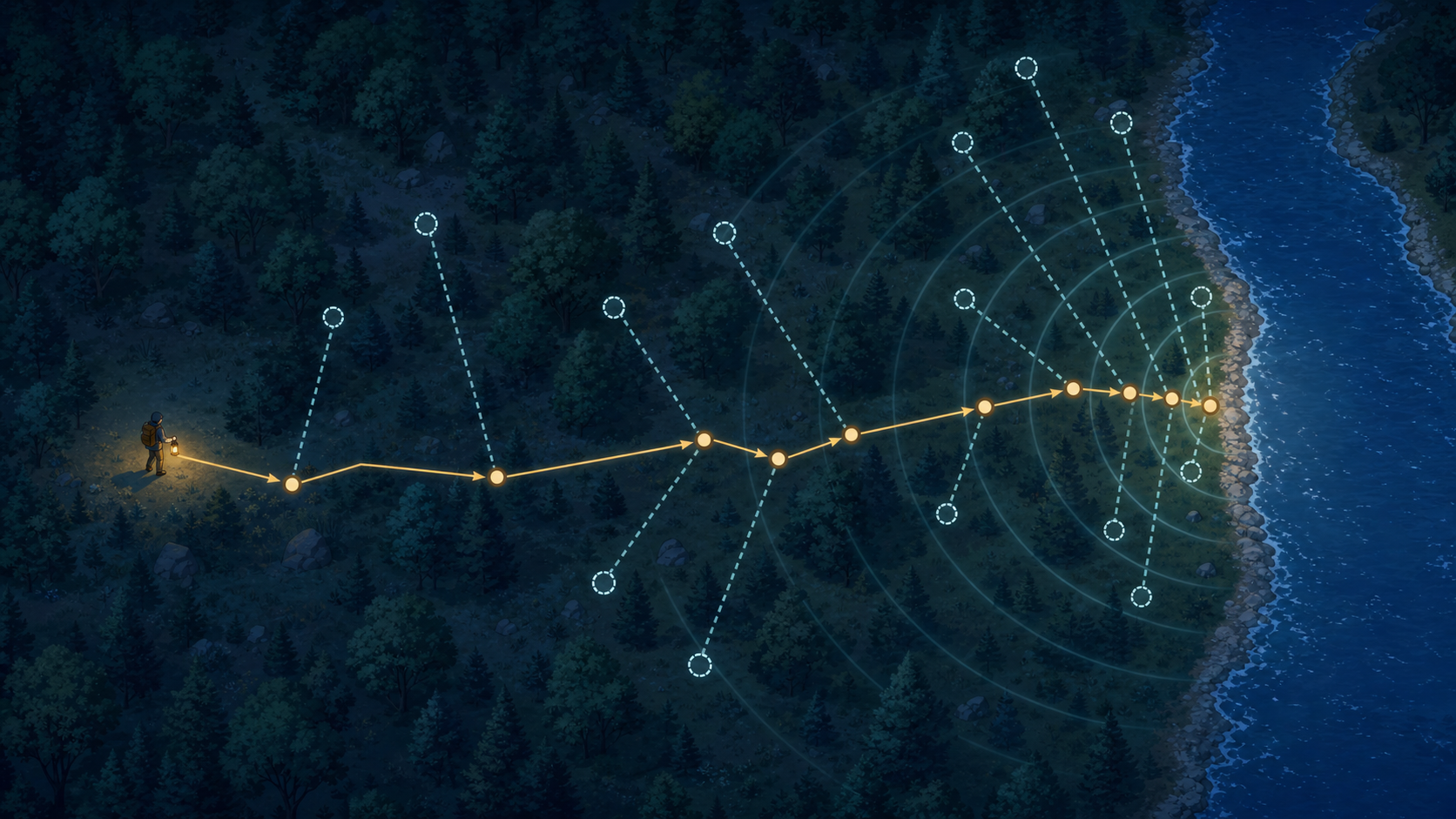
Stochastic approximation asks a simple question: if every observation is noisy, can repeated correction still reach the true target?
This series follows that question one knowledge card at a time. It begins with a hidden target and a noisy observation, derives the error recursion, studies how the step size balances correction against noise, and ends with the Robbins–Monro conditions and two routes to Dvoretzky’s convergence result.
The running example is a traveler trying to reach a river hidden in a forest. The traveler’s actual position is $w_k$. At step $k$, sound produces a noisy judgment $\text{target}_k$ of where the river lies, and the traveler walks a fraction $\alpha_k$ of the vector toward that judged location:
$$ w_{k+1}=w_k+\alpha_k(\text{target}_k-w_k). $$The true riverbank $w^*$ is fixed but unknown to the traveler. It belongs to the analyst’s view of the journey and appears only when we decompose the judgment as $\text{target}_k=w^*+\eta_k$.