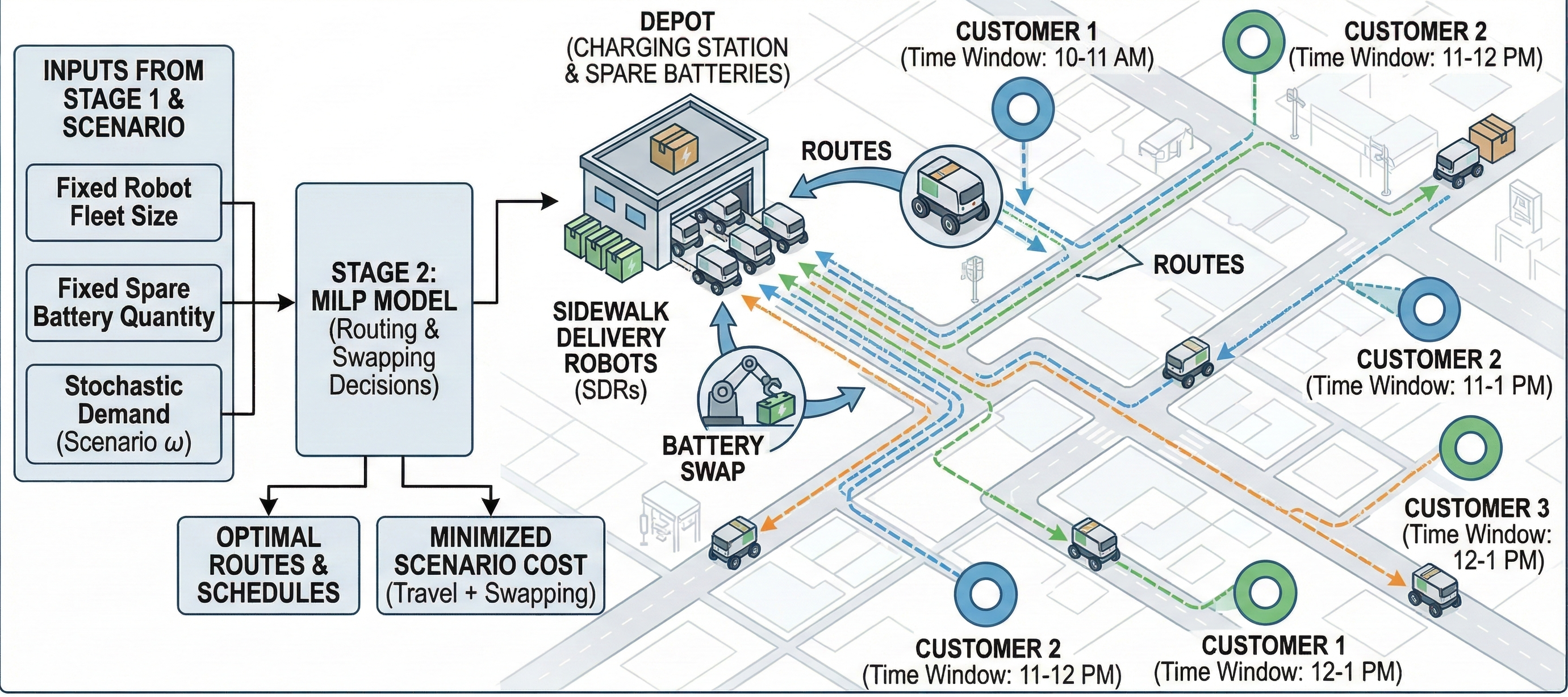
Paper at a Glance
- Title: Two-stage stochastic fleet and battery sizing with routing optimization for sidewalk delivery robots
- Authors: Yuchen Du, Hai Yang, Joseph Y. J. Chow, Tho V. Le
- Journal: Transportation Research Part E
- Year: 2025
- DOI: https://doi.org/10.1016/j.tre.2025.104220
This research was primarily conducted by Yuchen Du and Hai Yang, with significant contributions from Joseph Y. J. Chow and Tho V. Le.
Why This Study?
Sidewalk delivery robots (SDRs) are no longer futuristic prototypes — they are already delivering food and groceries on campuses and in dense urban areas.
But a practical question remains surprisingly hard to answer:
How many robots — and how many batteries — does an operator actually need?
This is not just a routing problem.
- Demand is uncertain.
- Robots have limited battery range.
- Charging is slow, so battery swapping becomes attractive.
- Over-provisioning is expensive; under-provisioning causes delays and poor service.
Most existing studies focus on operational routing given a fleet size.
We instead ask a more strategic question:
How should an SDR system be designed before demand is realized?
What We Did (In One Sentence)
We developed a two-stage stochastic optimization framework that jointly decides fleet size and battery provisioning, while explicitly accounting for routing decisions under uncertain demand.
The Key Idea
The challenge is scale.
- Solving routing problems for every possible demand scenario is computationally infeasible.
- Classical stochastic programming (e.g., SAA) quickly becomes too slow.
Our solution combines two complementary views:
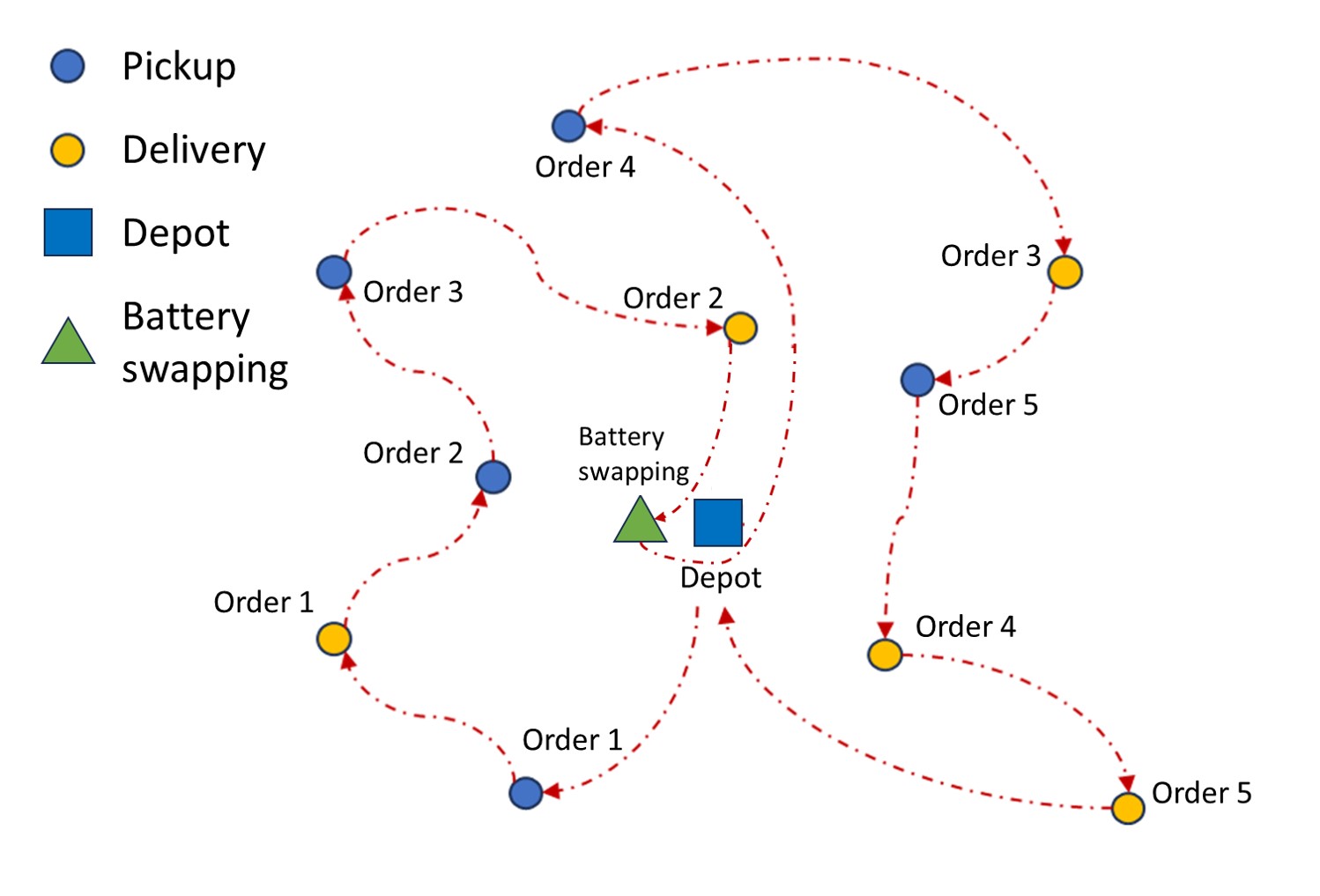
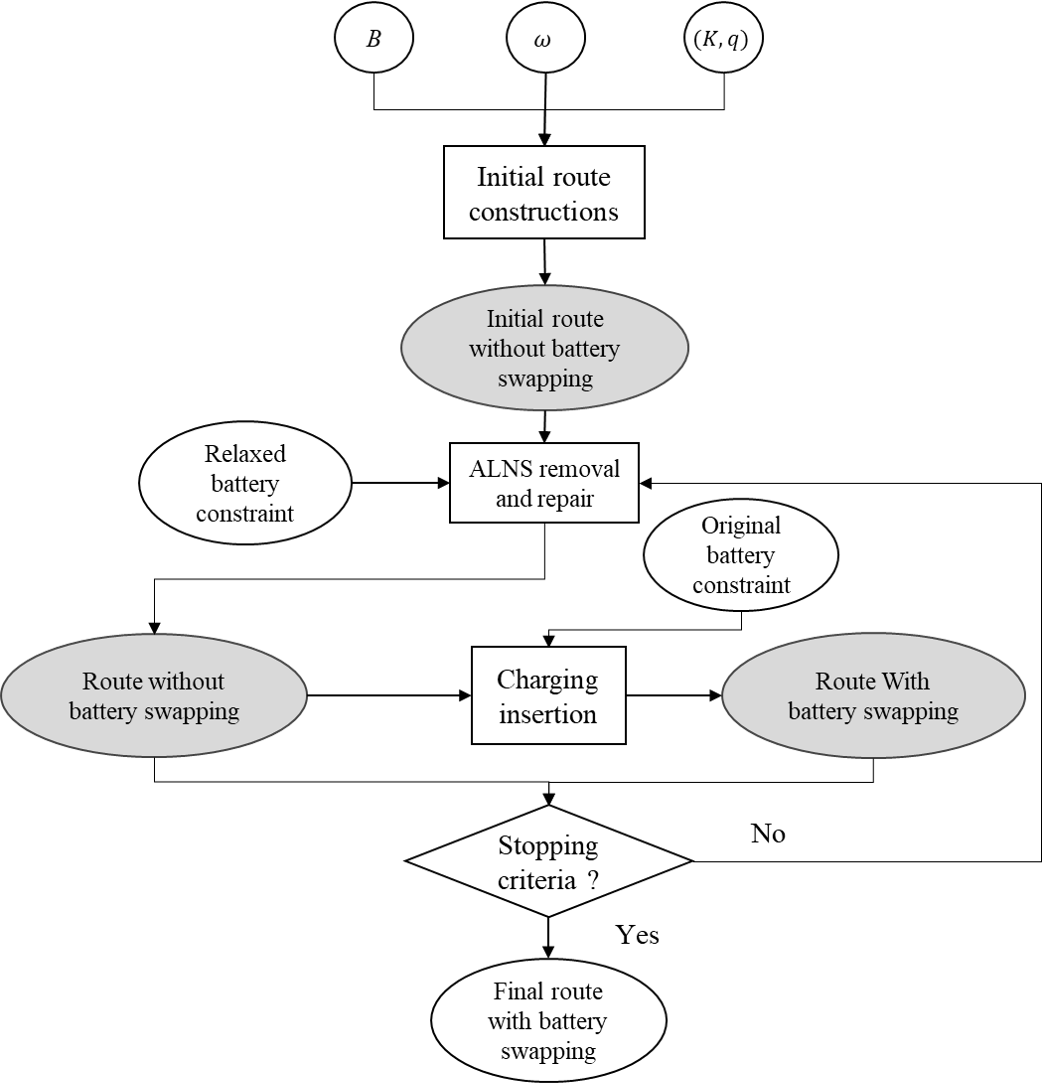
Detailed routing intelligence A customized pickup–delivery routing heuristic with:
- soft time windows,
- battery consumption,
- depot-based battery swapping.
Analytical system-level approximation
A continuous approximation model that captures average routing behavior without simulating every detail.
Together, they form a fast and scalable decision framework.
Why Battery Swapping?
For sidewalk robots, charging is not always practical during operation.
Battery swapping offers:
- fast turnaround,
- predictable energy recovery,
- simpler operational logic.
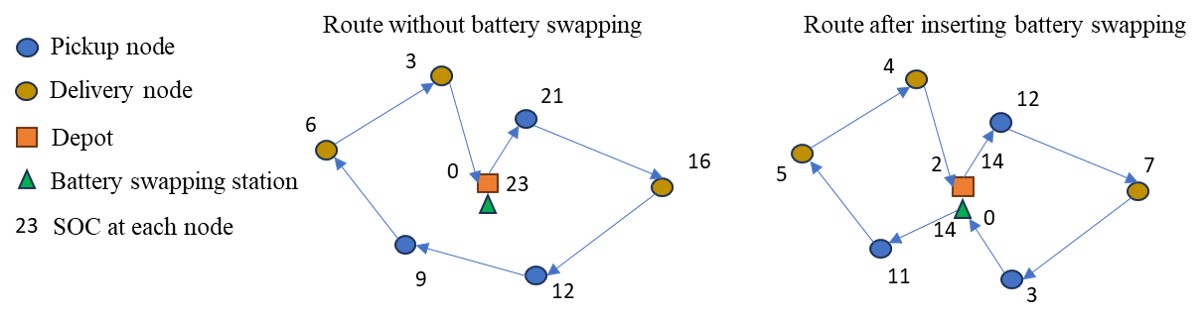
But swapping changes routing behavior and resource needs.
Our model explicitly captures:
- when robots need to swap,
- how many spare batteries are required,
- how swapping interacts with fleet size.
What We Found
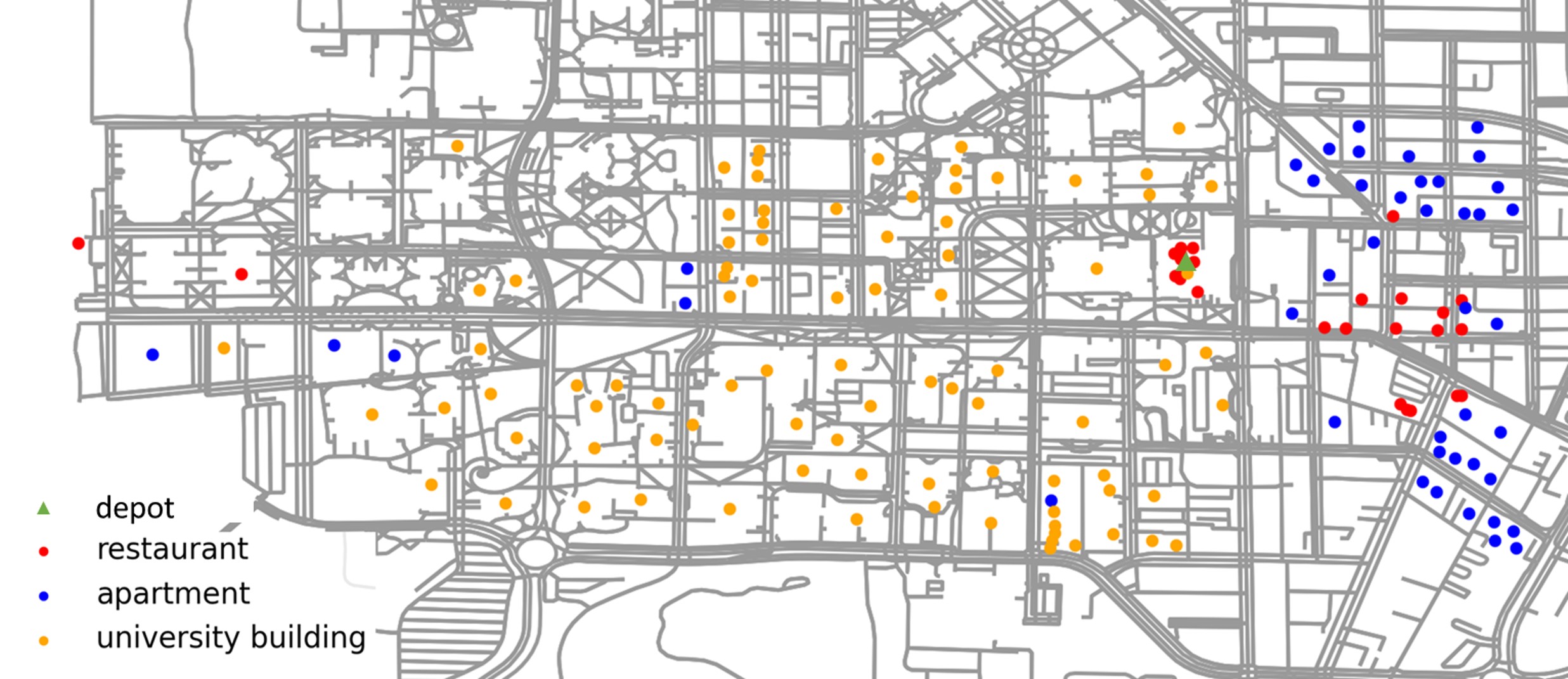
Across synthetic experiments and a real-world campus case study:
- The optimal fleet size is not monotonic with demand.
- Adding robots and adding batteries are substitutable but not equivalent.
- Continuous approximation provides near-identical decisions to classic stochastic programming — at a fraction of the computational cost.
- The framework scales to realistic demand levels where exact methods fail.
Why It Matters
This work sits at the intersection of:
- urban logistics,
- stochastic optimization,
- autonomous delivery systems.
It shows that:
- strategic design decisions cannot be separated from routing logic,
- approximation models can meaningfully guide real-world system design,
- SDR systems can be analyzed using tools that bridge theory and practice.
The framework is generalizable to:
- other electric delivery platforms,
- different charging or swapping policies,
- campus-scale or neighborhood-scale deployments.
Resources & Links
- 📄 Full Paper: https://doi.org/10.1016/j.tre.2025.104220
- 💻 Code Repository: https://github.com/dudusoar/VRP-Toolkit
Citation
@article{du2025two,
  title   = {Two-stage stochastic fleet and battery sizing with routing optimization for sidewalk delivery robots},
  author  = {Du, Yuchen and Yang, Hai and Chow, Joseph Y. J. and Le, Tho V.},
  journal = {Transportation Research Part E},
  volume  = {201},
  pages   = {104220},
  year    = {2025}
}