Paper at a Glance
- Title: Reviewing the Reviewer: Graph-Enhanced LLMs for E-commerce Appeal Adjudication
- Authors: Yuchen Du, Ashley Li, Zixi Huang
- Status: arXiv preprint, 2026
- arXiv: 2603.19267
Current status: this page now tracks the public arXiv preprint record only; earlier venue-status language has been removed.
This research was conducted during Yuchen Du’s internship at Amazon, in collaboration with Ashley Li and Zixi Huang.
Why This Study?
Large e-commerce platforms use fraud-detection controls to restrict seller accounts that appear risky. Some sellers appeal those restrictions, requiring investigators to reconstruct fragmented evidence, verification actions, and prior review decisions before deciding whether an account should be reinstated or remain blocked.
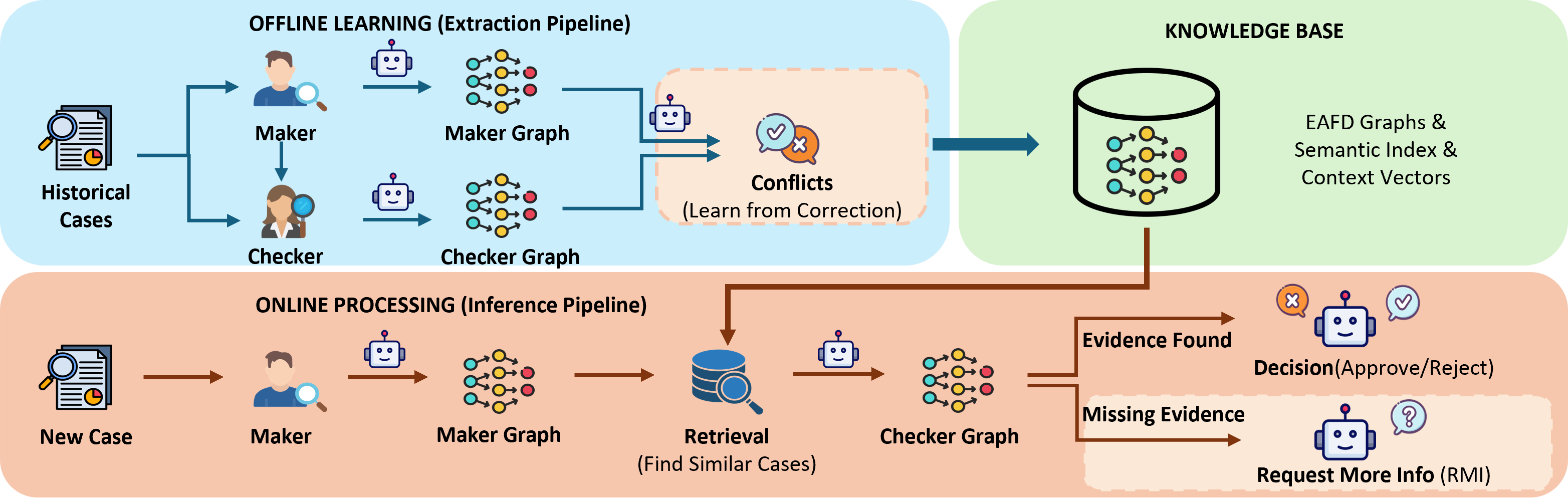
In the historical review process, a first reviewer — the Maker — examines the available evidence and makes a decision. A second reviewer — the Checker — audits that decision. Sometimes, the Checker overturns it.
That overturn is the interesting part.
When a Checker overturns a Maker’s decision, they are encoding exactly why the initial judgment was wrong.
These correction events are rare, high-quality, and deeply informative. But they are hard to learn from — because the Checker often had access to information the Maker never saw: external verification tools, cross-case precedents, additional investigation steps.
This is the information asymmetry problem.
A standard LLM reading the same case file as the Maker will make the same mistakes. It cannot know what it does not know. It will hallucinate a confident answer where the right answer is “I need more information.”
What We Did (In One Sentence)
We built a two-stage LLM agent that uses retrieval-augmented generation (RAG) with graph-based memory: offline, it converts historical evidence, verification actions, review factors, and decisions into structured graphs; online, it retrieves similar correction patterns to analyze and recommend outcomes for new appeals.
The Key Idea
The EAFD Schema
The core contribution is a new representation for adjudication reasoning: the Evidence–Action–Factor–Decision (EAFD) graph.
Most approaches try to go directly from evidence to decision. We argue this is where hallucination enters — the model skips the reasoning steps that a human reviewer would actually perform.
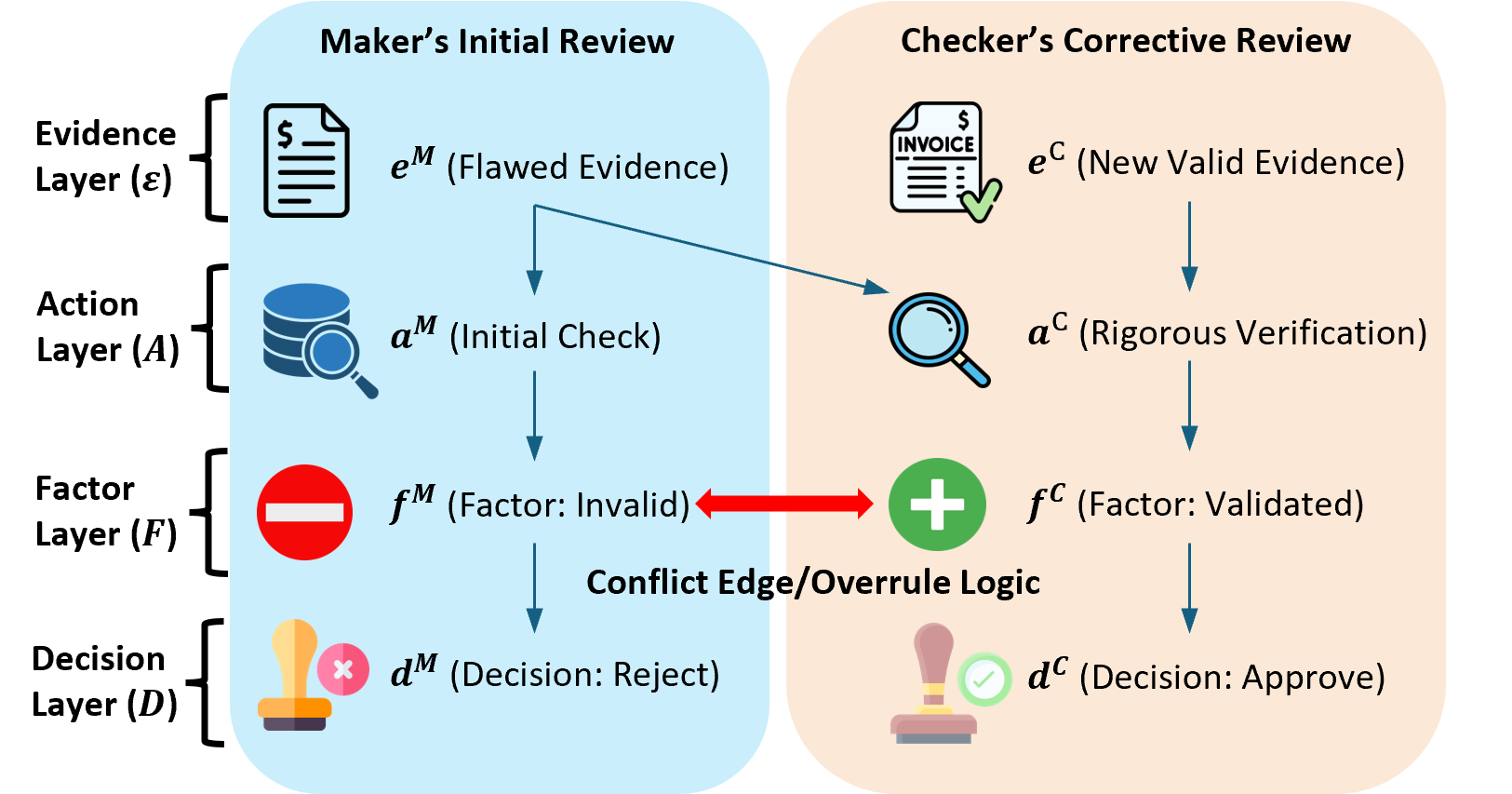
The EAFD schema inserts two intermediate layers:
- Evidence (E): atomic facts extracted from the case file — invoices, emails, complaint records
- Action (A): the verification steps a reviewer actually performs — checking inventory records, contacting suppliers, querying external databases
- Factor (F): the abstract judgment criteria derived from those actions — whether FIFO compliance was validated, whether supplier trust was established
- Decision (D): the final adjudication outcome — Approve, Reject, or Request More Information
The Action layer is the key innovation. It grounds LLM reasoning in verifiable operations rather than unconstrained text generation. Without it, the model jumps from evidence directly to judgment — exactly the shortcut that produces hallucinations.
Learning from Conflict
For each historical case where a Checker overturned a Maker, we construct two EAFD graphs — one for the Maker’s reasoning, one for the Checker’s — and explicitly model the conflict edges between them.
These conflict edges are the learning signal. They capture, structurally, what the Maker missed: which verification actions were skipped, which factors were misweighted, which evidence was overlooked.
The knowledge base aggregates conflict-annotated graphs from historical reviewed cases, forming a retrievable repository of adjudication precedents.
Online Reasoning
In the online stage, the agent follows a four-phase reasoning process:
- Retrieval: find the most similar historical cases from the knowledge graph using embedding-based search
- Checker graph projection: derive what the Checker’s resolution path would look like for this new case
- Deductive inference: reason top-down from Factor to Action to Evidence, validating each step
- Adjudication: produce a final decision with full reasoning trace
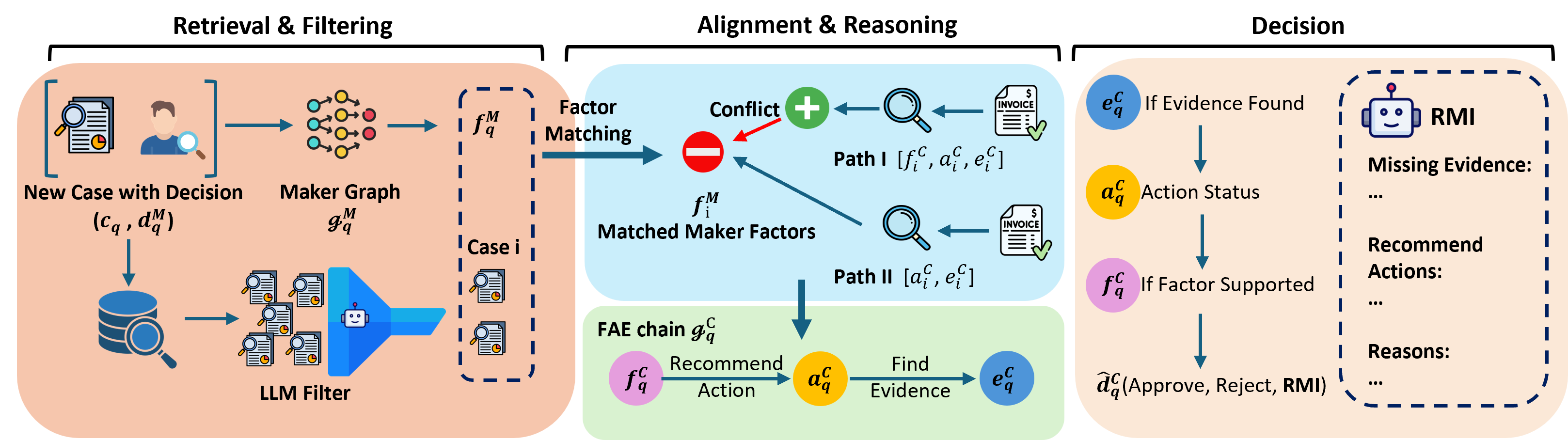
A distinctive capability is the Request More Information (RMI) outcome. When the evidence is insufficient — when a required verification action has no corresponding evidence — the system does not force a premature decision. Instead, it identifies precisely which actions remain unexecuted and generates targeted information requests for the seller.
This “knowing what you don’t know” capability is one of the most practically valuable features for real-world deployment.
What We Found
| System | Alignment with Human Experts |
|---|---|
| LLM-only baseline | 70.8% |
| + Action modeling with RMI | 87.5% |
| + Retrieval-based knowledge graph | 95.8% (offline) |
| Production deployment | 96.3% |
The jump from 70.8% to 87.5% comes entirely from introducing the Action layer — before any retrieval or knowledge graph. This isolates the contribution of action modeling and confirms that information asymmetry is the core problem.
Adding the knowledge graph pushes performance further, as the system can now leverage verified resolution paths from similar historical cases rather than reasoning from scratch.
In production, the framework maintains 96.3% alignment with human Checker decisions — demonstrating that the offline gains transfer to real-world deployment.
Why It Matters
This work sits at the intersection of:
- LLM reasoning and hallucination prevention,
- knowledge graph construction from human correction signals,
- industrial deployment of AI decision-support systems.
The EAFD framework is not specific to e-commerce. Any domain with hierarchical human review generates the same kind of correction signals: legal appeals, medical second opinions, financial compliance audits. The same approach applies wherever a second reviewer’s overturn encodes structured knowledge about why the first reviewer was wrong.
Resources & Links
- 📄 arXiv: arXiv:2603.19267
- 📄 Status: arXiv preprint, 2026